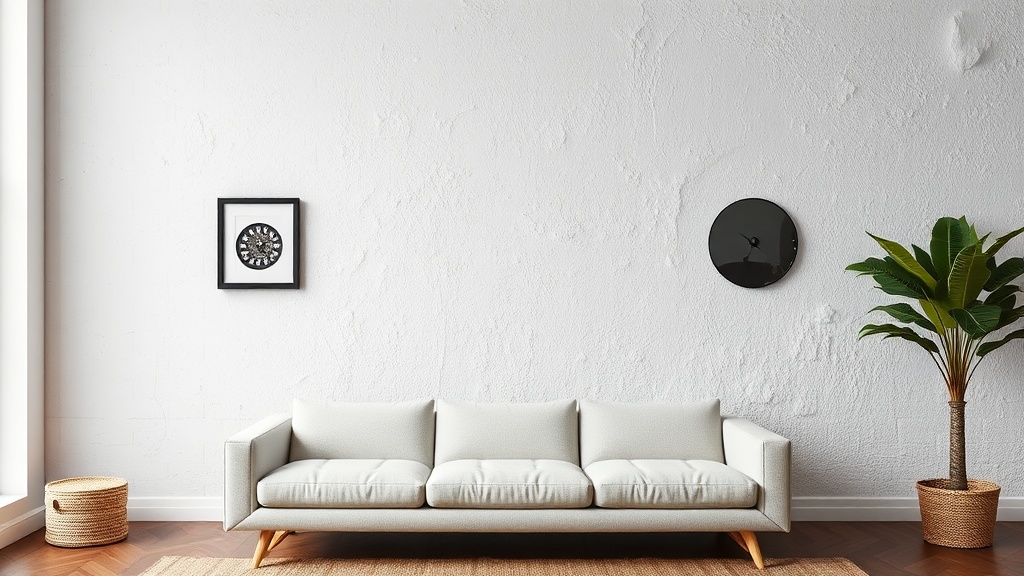
Swap Your Basic White Walls for These High-Impact Textures

Peel and Stick Textured Wallpaper
Large Scale Fabric Wall Hangings
Woven Basket Wall Displays
Floating Wood Slat Panels
Macramé and Textile Art
Most renters and new homeowners believe that white walls are the safest bet for a neutral, sophisticated look. They think a blank canvas makes a room feel larger or cleaner, but the reality is that flat, matte white paint often makes a space feel sterile, cold, and unfinished. This post covers how to move beyond flat paint by introducing tactile elements like limewash, wood paneling, and textured wallpaper to add depth to your living space. Adding texture is the most effective way to make a small apartment feel expensive without a full renovation.
What is Limewash Paint and Is It Worth It?
Limewash is a natural, mineral-based paint that creates a soft, mottled, and weathered appearance on your walls. Unlike standard latex paint that sits on top of a surface, limewash reacts with the substrate to create a depth that looks like aged plaster or stone. It’s a perfect option if you want a "lived-in" feel rather than a showroom-perfect look.
The process of applying limewash is a bit more involved than rolling on a standard gallon of Behr or Sherwin-Williams paint. You have to apply it in thin, irregular layers using a large brush to achieve that characteristic movement. If you do it perfectly straight, it'll look weird—the whole point is the slight imperfection (which is actually a good thing).
Pros and Cons of Limewash
| Feature | Limewash Paint | Standard Latex Paint |
|---|---|---|
| Finish | Matte, mottled, textured | Flat, eggshell, or satin |
| Application | Requires brush strokes/layers | Simple roller or spray |
| Durability | High (breathable/natural) | Variable (depends on sheen) |
| Visual Depth | Very High | Low/Flat |
One thing to keep in mind: limewash is highly breathable. This makes it a great choice for older homes with plaster walls, as it helps regulate moisture. You can find high-quality mineral paints from brands like Romabio, which is a leader in the lime-based paint space. Just don't expect a uniform color; the "streaks" are what give the wall its character.
How Can I Add Wood Texture Without Installing Permanent Paneling?
You can add wood texture using removable peel-and-stick wood planks or lightweight decorative moldings that don't require permanent structural changes. This is a lifesaver for anyone living in a rental where you can't exactly nail up oak wainscoting without losing your security deposit.
If you want a high-end look without the carpenter's bill, look into high-quality textured wallpapers or even lightweight fluted panels. Fluted textures—those vertical grooves you see on modern furniture—are huge right now. Adding a fluted panel to a small section of a wall can act as a focal point. It draws the eye upward, making your ceilings feel higher.
If you're worried about the "cheap" look of some DIY wood products, try this:
Don't use the ultra-shiny, faux-wood contact paper. It looks terrible in natural light.
Instead, look for matte finishes or actual wood veneers. If you're looking to change the vibe of a room through furniture rather than walls, you might want to stop buying matching furniture sets and start incorporating different wood grains to create a more organic, layered feel. A mix of walnut, oak, and pine creates much more visual interest than a single, matching set of honey-oak furniture.
Are Textured Wallpapers Better Than Paint?
Textured wallpapers are often better than paint when you want to introduce a specific pattern or a heavy tactile element like grasscloth or linen. While paint only changes the color and a slight sheen, wallpaper can completely change the "weight" of a room by adding physical dimension.
Grasscloth is a classic for a reason. It’s made from natural fibers and has a subtle, organic texture that looks incredible in dining rooms or bedrooms. It’s not a "loud" pattern, but it feels much more substantial than a flat wall. It’s a bit more delicate, though—you won't want to put it in a high-traffic hallway where people might scuff it with their shoulders.
Here are a few types of textured wall treatments to consider:
- Grasscloth: Natural, organic, and sophisticated. Great for bedrooms.
- Fluted Panels: Modern, architectural, and adds verticality.
- Faux Stone/Brick: Best used sparingly as an accent wall to avoid looking like a themed restaurant.
- Fabric Wallcoverings: Adds warmth and sound absorption (great for echoey apartments).
The catch? Installation can be a headache. If you aren't using a high-quality peel-and-stick version, you'll need professional tools. According to the Wikipedia entry on wallpaper, the history of wall coverings is long, but the modern versions are much more user-friendly than the heavy, paste-heavy versions of the past. If you're a renter, stick to high-end peel-and-stick options to ensure you can remove them without stripping the drywall underneath.
How Much Does It Cost to Add Wall Texture?
The cost of adding wall texture varies wildly depending on whether you are buying DIY materials or hiring a professional. A bucket of limewash paint might cost you $50 to $100, whereas professional plaster work or custom wood paneling can run into the thousands.
If you're on a budget, start with small-scale changes. A single accent wall using a textured peel-and-stick product is a relatively low-risk investment. It’s much cheaper to experiment with a textured wallpaper on one wall than it is to repaint an entire apartment. If you decide you hate it, you can pull it down or paint over it.
Budget Breakdown (Estimated)
- Limewash DIY: $60–$150 (includes paint and basic brushes).
- Peel-and-Stick Grasscloth: $100–$300 per roll.
- Decorative Molding/Wainscoting: $50–$200 (depending on length and material).
- Professional Plastering: $500–$2,000+ (depending on square footage).
Worth noting: don't forget to factor in the cost of the tools. You can't just use a standard roller for limewash; you'll need a specific brush to get the right effect. It’s a small expense, but it's the difference between a professional look and a messy one.
Texture isn't just about the walls, though. If you've already addressed your walls and your room still feels "flat," you might need to look at your textiles. A room with flat walls and flat fabrics feels like a waiting room. If you're still struggling with the "flatness" of your space, you might want to try window layering instead of just hanging a single curtain rod. Adding depth to your windows can complement the new texture on your walls perfectly.