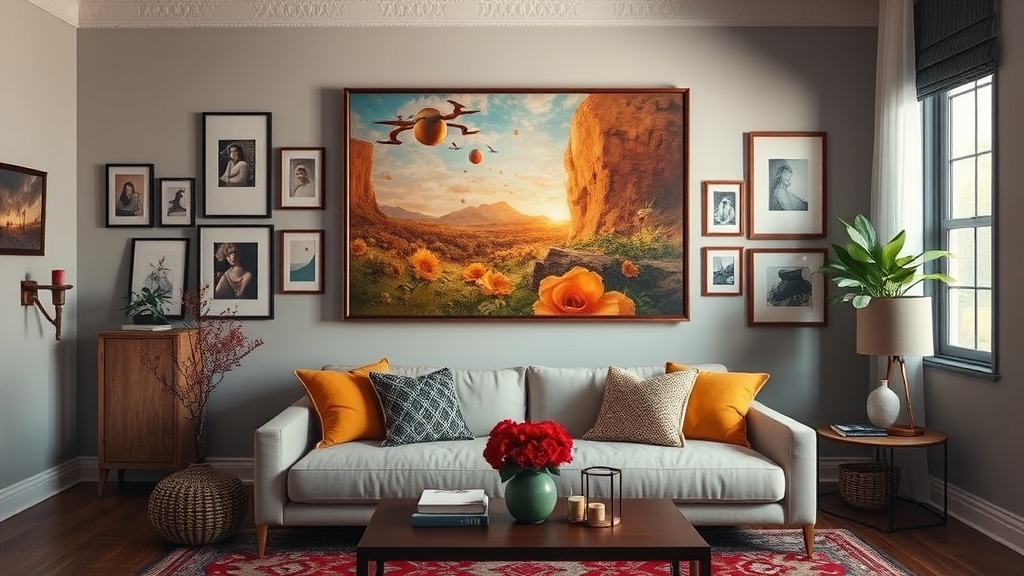
Stop Using Small Gallery Walls and Try One Large Statement Piece Instead

The common assumption in interior design is that more is better. When you have an empty wall in a studio or a one-bedroom apartment, the instinct is to fill that negative space with a collection of small, mismatched frames to create a "gallery wall." While this approach is popular on Pinterest, it often results in visual clutter that makes a small room feel fragmented and disorganized. Instead of creating a focal point, a small gallery wall creates dozens of tiny distractions that pull the eye in too many directions. Replacing that cluster of small items with one large, intentional statement piece simplifies your visual landscape, makes your ceilings feel higher, and gives your living space a more sophisticated, curated look.
The Problem with Small Gallery Walls
Small gallery walls often suffer from "visual noise." When you hang ten or fifteen small frames of varying sizes, the eye has no single place to rest. This constant movement can make a room feel smaller and more chaotic than it actually is. Furthermore, maintaining a gallery wall is a logistical headache. You have to ensure every frame is perfectly leveled, and if you decide to move furniture, you are left with a confusing pattern of holes in your drywall. If you are using alternatives to Command hooks to avoid damage, you will quickly find that managing a dozen different hanging points is much more difficult than managing one.
Beyond the maintenance, there is the issue of scale. Most people living in first apartments buy art that is too small for their walls. They buy 8x10 prints and put them in standard frames, then try to group them together to fill the space. This is a mistake. Small art on a large wall looks like an afterthought rather than a design choice. A single large piece of art—something at least 36 inches wide or even larger—commands the room and establishes a clear sense of scale.
Why One Large Piece Works Better
A single statement piece acts as an anchor for the entire room. It provides a visual destination for the eyes. When you walk into a room with one large, striking canvas or a framed textile, your brain registers it as the primary feature. This creates a sense of order. It also allows you to use the art to dictate the color palette of the rest of the room. If you have a large abstract piece with deep navy and ochre tones, you can pull those colors into your throw pillows or a single accent chair, creating a cohesive design language.
- Reduced Visual Clutter: One object means one focal point, leading to a calmer environment.
- Easier Installation: Hanging one heavy-duty picture wire or a single bracket is simpler than measuring a grid for twelve frames.
- Higher Perceived Value: Large-scale art tends to look more expensive and intentional than a collection of small, cheap prints.
- Versatility: It is easier to swap one large piece when you change your style than to reconfigure an entire gallery.
How to Choose a Statement Piece
Selecting the right piece requires moving away from the "buy what looks cute" mentality and moving toward "buy what fits the scale." You are looking for something that has enough visual weight to hold its own against your furniture. If you are hanging art above a mid-century modern sideboard or a standard three-seater sofa, the art should ideally be about two-thirds to three-quarters the width of the furniture below it.
Consider Texture and Medium
A statement piece doesn't have to be a traditional framed painting. In fact, varying the medium can add much-needed texture to a room that might otherwise feel "flat." Consider these options:
- Textile Art: A large macramé hanging or a framed piece of vintage fabric adds warmth and softens the hard lines of a room.
- Abstract Canvas: An oversized, unframed canvas provides a modern, clean look that doesn't require the extra bulk of a frame.
- Architectural Elements: A large, circular mirror or a sculptural wooden piece can act as a statement while also serving a functional purpose, such as reflecting light to make a small Seattle apartment feel brighter.
- Photography: A single, high-quality black and white landscape print can provide a sense of depth and "window" into another space.
The Role of Color and Composition
When choosing a large piece, look at the composition. If your room is filled with many small objects—books, plants, coffee table trays—your statement piece should be relatively simple to avoid overwhelming the space. If your room is very minimalist, you can afford a piece with a more complex, high-contrast pattern. Avoid pieces that are too "busy" if they are going to be the only thing on the wall, as they can become exhausting to look at over time.
Installation and Placement Strategy
The biggest mistake people make when hanging large art is hanging it too high. A common error is placing the center of the piece near the ceiling. This makes the art look like it is "floating" away from the furniture. For the most professional look, the center of your statement piece should be at eye level—roughly 57 to 60 inches from the floor—or positioned so that the bottom of the frame is 6 to 10 inches above your furniture (like a sofa or a console table).
Dealing with Weight and Wall Integrity
Because you are moving away from many small items to one large item, you must consider weight. A large framed piece or a heavy mirror requires more than just a standard nail. If you are renting, you need to be strategic about how you secure these items to avoid losing your security deposit. Instead of relying on lightweight adhesive strips, look for heavy-duty wall anchors or professional-grade picture hanging kits. If you are hanging a very heavy piece, ensure you are hitting a stud in the wall or using a high-quality toggle bolt.
"The scale of your art should be a direct response to the scale of your furniture. If the art is smaller than the sofa, it will look like it's shrinking the room."
Balancing the Room with Lighting
A large statement piece is only as effective as the light hitting it. If you hang a beautiful, large-scale canvas in a dark corner, it will just look like a dark mass. To truly make the piece pop, you should integrate it into your lighting plan. Rather than relying on a single overhead bulb, use a dedicated picture light or a floor lamp positioned to cast light toward the piece. This creates a "museum effect" and adds depth to your living area. If you haven't already, look into layered lighting techniques to ensure your new focal point is properly illuminated.
Practical Checklist for Your New Wall
Before you commit to a large piece, run through this checklist to ensure it is the right move for your specific space:
- Measure the Wall: Use painter's tape to outline the dimensions of the piece you intend to buy directly on your wall. Leave the tape there for 24 hours to see if the scale feels right.
- Check the Lighting: Observe how shadows fall on that wall throughout the day. Will the piece be obscured by a shadow from a window or a bookshelf?
- Evaluate the Furniture: Is the piece at least 2/3 the width of the furniture below it? If it's significantly smaller, it will look disconnected.
- Verify the Weight: Check the weight of the item and ensure you have the correct hardware (anchors, studs, or heavy-duty hooks) to support it.
By moving away from the cluttered look of a small gallery wall and embracing a single, large-scale statement piece, you elevate your apartment from a collection of "stuff" to a curated home. It is a simple shift in philosophy that yields significant results in how your space feels, functions, and looks to guests.